
#6: Building a gyroplane


Ten years ago, when I was learning all about Magni gyroplanes and learning to fly one, I read an article in a flying magazine by someone who had traveled to Italy to build one at their factory. I thought that was such a cool idea - you would be getting a brand-new aircraft, get to build it yourself so you would know all about it, but getting to do it with the craftsmen and engineers of Magni looking over your shoulder; helping, and ensuring everything is done perfectly. Ideal! In April 2026, after 10 years of wanting to do this, I finally traveled to the factory in northern Milan and spent the time with the Magni team going through the build process to build a brand-new M24Xtreme.
It was a wonderful experience. Magni is still very much a family business. Vittorio, the founder and patriarch of the business, still comes in every day, even though he's now 88. I had the privilege of meeting and interacting with him and was fascinated to watch him still using drills and lathes as he worked on tasks in the factory. His two sons, Luca and Pietro, run the business now - Pietro in charge of Operations and Luca running Assembly, Sales and Marketing and R&D.
I arrived in Milan on the Sunday night and reported for duty on Monday morning. I was welcomed, given a place to put my things and offered coffee. I have to say that this was the one disappointment of the trip. Their coffee machine, while sophisticated, slightly temperamental and definitely Italian, did not produce the spectactular cappucini I had imagined! But moving quickly past this, we went to the factory floor and I was introduced to the Magni experts building the gyros who would be helping me and keeping me on the right path. There are 6 build stations and they build 6 or 7 gyros a month at present. I was assigned a station, tasks were handed out and explained and I started. I was happy to realize I was being given tasks only at the pace I could handle. I have some basic mechanical aptitude, but I'd never done anything like this before and I was very impressed by the way they adapted the pace to me.
The frame - the pre-welded keel and mast - was in place on the build jig. It had been painted prior to my arrival but there was nothing attached and it was pure bare-bones.

But by lunchtime, we had added various parts to the frame, started attaching the cabling and engine control electronics and hung the Rotax 915i engine on it.

Then I added the pre-fabricated rotor head to the top of the mast and started installing the control rods that move it relative to the joystick. By early afternoon, the carbon fiber shell was added onto the frame and secured in place and the rear panels were attached with temporary fastenings to check they all fit correctly. There were seats inside and it already looked like a gyro!
However, the next morning it felt like we went backwards in that we took the seats back out and all the rear panels off again to begin adding rivets with screw-in fastenings for the panels to be fixed on properly. We added the doors and ran control lines and the remaining control rods to connect up the pilot controls, including throttle, cyclic and rudder pedals. After another fine Italian lunch (they took me to nice restaurants each day), we resumed with adding the firewall and cabling. The tail was attached and the final task of the day was to glue the special window material into the doors. This is a clear plastic material but it's very hard-wearing. The glue takes 12 hours to cure so we needed to leave them overnight.

Day 3 was about connecting everything together. The firewall, fuel tank and seats went in, the engine systems got connected - fuel, oil and coolant - the wheels and tires were added, the propellor, the instruments, panel and switches all went in. The final job of the day was the gluing of the front windshield, which then needed overnight to cure.
The video below shows an abbreviated version of the first 3 days of the build, including some timelapse footage.
On day 4, we basically finished the assembly of the remaining parts, completing all aspects of connecting the engine into its supporting systems, finishing the wiring of the instrument panel and switchgear, adding the front fork and suspension (which had arrived from painting just in time), and buttoning everything else up securely. In the afternoon, we wheeled the new gyro outside, attached it with heavy-duty webbing straps to a truck and started the engine. After checking everything was running correctly and giving the oil a chance to warm up, we ran it up to full takeoff power and allowed it to run there for a minute, checking all the gauges for expected values.
That evening we put it on a trailer ready for flight testing the next day and I went back to my hotel and enjoyed a pizza and a glass of wine.
Magni has access to an airfield about 45 mins drive from the factory, south-west of Milan. We drove the gyro there on the morning of day 5 and unloaded it. Then we mounted the rotor on the top. Rotor blades are one of Magni's bits of special magic. The blades are a special design made of different types of fiberglass and are high inertia, meaning they are very forgiving in flight. The factory makes one blade per day and then matches each blade with its sister for weight and balance. Each blade weighs 18kg (~45lbs) and once balanced, they are matched within 1gram!
We got in the gyro, started the engine and taxied out to the grass strip. After attaching a rotor balancer rig (a 2D accelerometer and optical rev meter), we took off - just like that! Luca was flying left seat and we flew for only a few minutes that first time, sampling and recording data from the balancer, then landed to adjust the rotor. This can be done in seconds once you've looked at the polar plot of vibration recorded by the balancer. (At least, it can be once you've accumulated enough experience to understand what the graph means!) We did a total of 7 short flights, adjusting each time, and by the 7th, the rotor was dialed in to perfection with very minimal vibration.
I then got the chance to go for a longer flight with Paolo, Pietro's son, who works in the factory and is an expert pilot. This was my first chance really to do some of the flying, though I was flying right seat for license and insurance reasons.
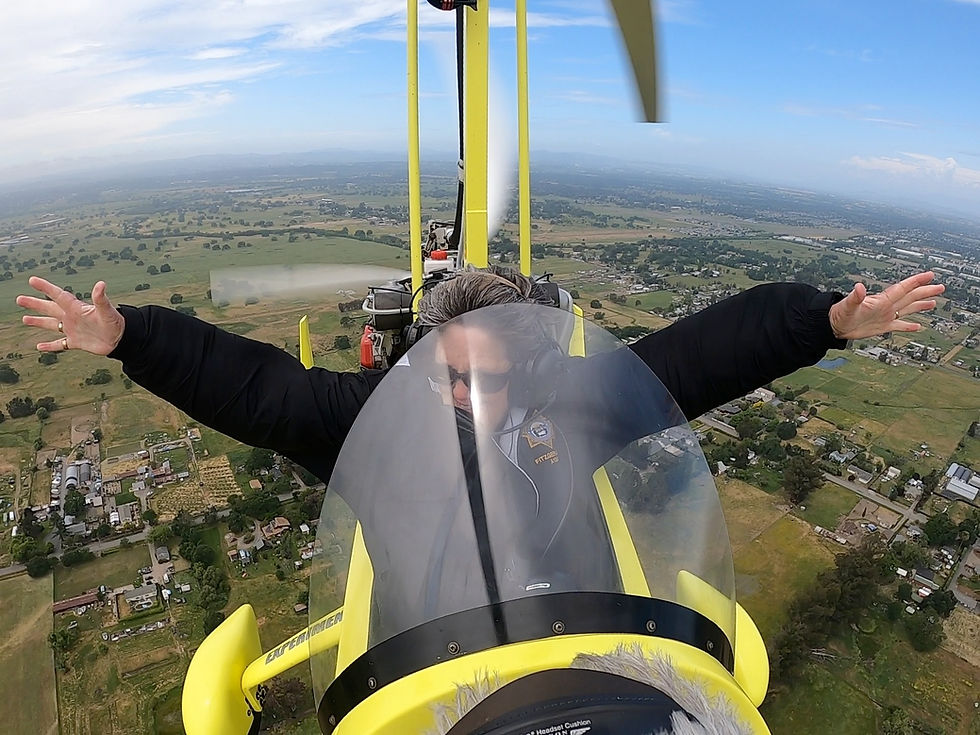
On the final day I met Luca again at the airfield and we were able to fly both morning and afternoon. In the morning I could fly left seat as Luca is an instructor, so I got to do a good number of takeoffs and landings and get the feel of the aircraft and how it's different from the M16 I've been flying for 10 years. In the afternoon, we flew again and I received a masterclass from Luca in emergency landings and short approaches, really demonstrating how to manage the energy in the rotor - fantastic experience.
And that was it. We put the gyro back in their hangar ready for its trip to the port -once the other gyros due to be shipped to the USA were ready. It's possible to fit 4 gyros into a single container which then gets carried by container ship to a port in the USA and imported there. This is very cost-effective and just means you have to wait until the others are ready. Then after thanking the Magni team for all their help and support, I bid them farewell and headed home.
So what kind of build experience is this? The reality is that it's more "assembly" than a "build". The six most critical parts of the aircraft - the rotor blades, rotor head, welded frame, carbon fiber shell, engine and avionics - are already built, and what you are really doing is fitting them all together. But it's none the worse for that and no different from many other accelerated build programs. There's no way that it would be sensible for anyone to attempt to do any of those items themselves and the fact that they are pre-built means that not only do you get the job done in the week you are there, but the quality of the finished product is massively higher. This is also true about doing the build at the factory, with Magni personnel watching over you. I am extremely grateful for the supervision I received and am confident that the build was done to Magni quality standards. If I had tried to do it from a kit by myself, I would not be able to say that with the same confidence. Although with the new MOSAIC rules it will no longer be necessary for gyros to be classified as Experimental-Amateur Built, I would highly recommend the experience to anyone who wants to really understand the aircraft they are buying.


Comments